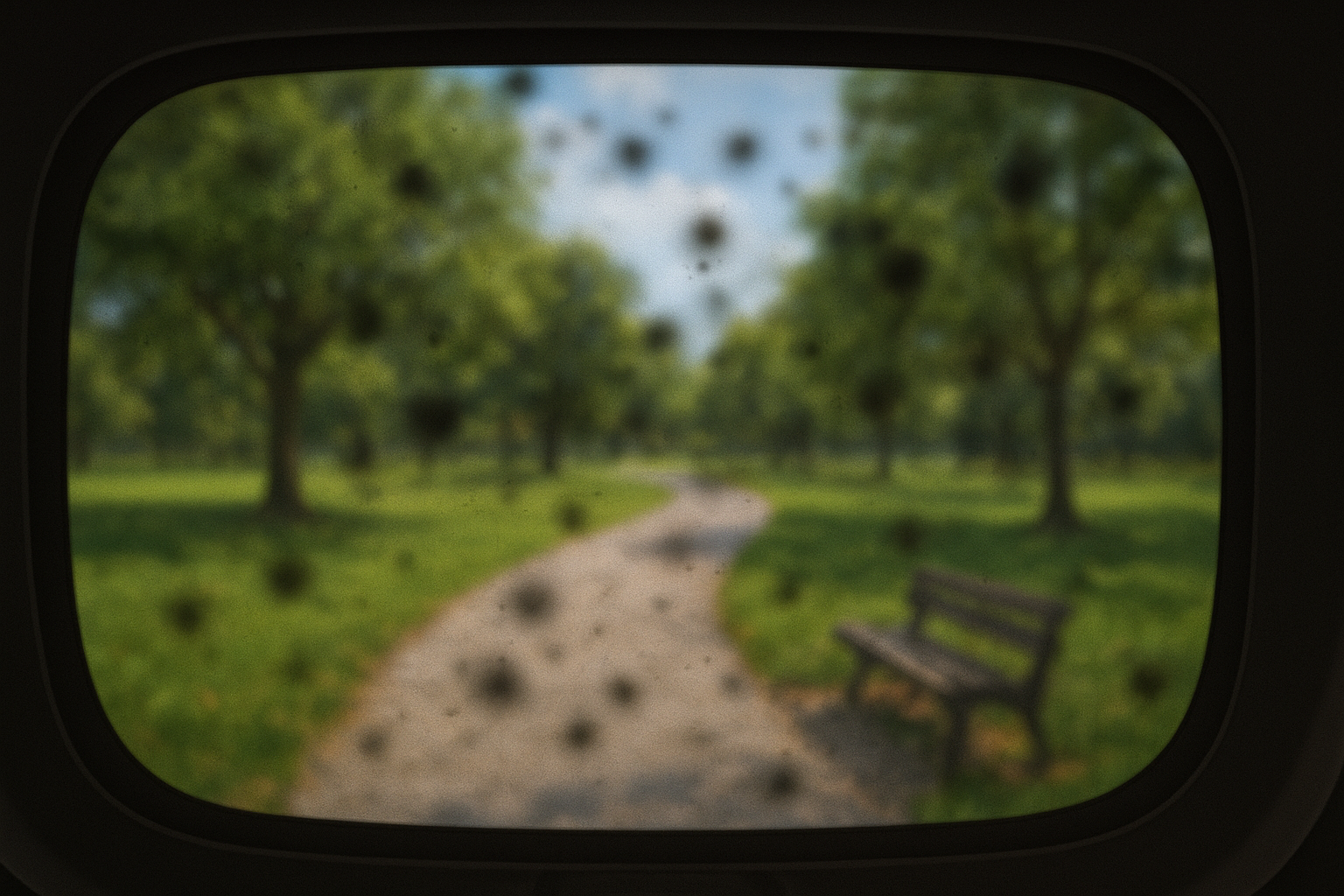
What floaters look like in the augmented reality experience: Eye-R.

Eye-R

Bridging the gap between Gen Z & preventable eye care through an immersive augmented reality experience.
Details
• Figma &  Rhino 7
• Alcon (Capstone Partnership)
• Lead Designer & Developer
• January- May 2025
Skills
• Experience Design
• Concept Development
• Project Managment
• Stakeholder Managment
THE PROBLEM

Why Should We Care?

Gen Z doesn’t think about eye health until it’s too late. While most understand the basics, few can recognize long-term damage before symptoms appear. This gap makes prevention nearly impossible.

43%

of Gen Z indicated that their eye health has gotten worse over the past year

60%

of Gen Z blinks less when on their devices, leading to painful eye problems later on
Source:Alcon

6 in 10

Gen Zers require some form of vision correction
Research

Understanding the Users

To better understand Gen Z's relationship with eye health,  mixed-method research was conducted such as surveys, interviews, secondary research, & analyzed the competition . The goal was to uncover not just what they knew, but what they didn't know they were missing.

80+  

Survey Responses
Understood Gen Z's baseline, behaviors, and motivations around eye health

20+

user interviews
Explored personal experiences, attitudes, & emotional relationships with eye care

1 in 3   

Survery & Interviews
Activley wear glasses or contacts

38%

Survery and Interviews
Know some form of preventative eye care

Key Findings

01
Eye health information exists but it's overly clinical and text heavy. It's not marketed towards Gen Z, so they disengage with it before they even start.
Source: Secondary Research
02
Participants know they should care about their eyes, but they don't fully understand the consequences until it inevitably happens. Awareness without experience doesn't change behavior.

Source: User Interviews
03
Many within Gen Z get information related to their eyes by going to an optometrist when an issue arises, not from seeking it out themselves.
Source: User Interviews
04
Gen Z does not actively prioritize eye health despite being one of the most at-risk groups due to heavy screen usage.                
Source: Surveys & Interviews
User persona

Meet Theo

Theo Green

Age: 20
Full-time College Student
Online Coursework
Dallas, TX
BIO

Theo is a full-time college student whose entire life happens on a screen. After months of eye strain, headaches, and blurred vision, he finally went to an eye doctor only to learn the damage could have been prevented. Now, he’s trying to manage something he didn’t even know he needed to worry about. He can’t undo what’s already happened, and wishes someone had told him before it got this far.

GOALS
  • Feel like it's not too late to take control
  • Manage screen time without falling behind
  • Know what actions actually help
FRUSTURATIONS
  • Nobody told him this was preventable
  • Health information feels clinical and scary
  • Can't afford to cut back on screen time due to school
QUOTE
“If I had known this was preventable, I would’ve done something sooner.”
The opportunity

From Research to Direction

Research informed us that the gap was not that of lack of information but rather the way that information was presented. Traditional formats like websites fail to create an urgency or a lasting behavioral change.

How might we make the consequences of eye care neglect tangible, immediate, and impossible to ignore?

Ideation began with an informational app, but quickly recognized that if websites weren't creating urgency, an app wouldn't either. Then a video game format was explored as  it's engaging, but unrealistic as a public health tool. A second round of user interviews pointed toward something more immersive. The consistent response was clear: people wanted an experience so immediate they had no choice but to pay attention.

The Solution

Introducing Eye-R

Eye-R is a free augmented reality experience aiming to educate Gen Z on what will happen if they fail to take care of their eyes. Eye-R meets Gen Z where they are and turns any environment into a whole new experience. Users will see what it's like to 'live' with different preventable eye conditions, while walking them through the symptoms and what they can do to prevent it.
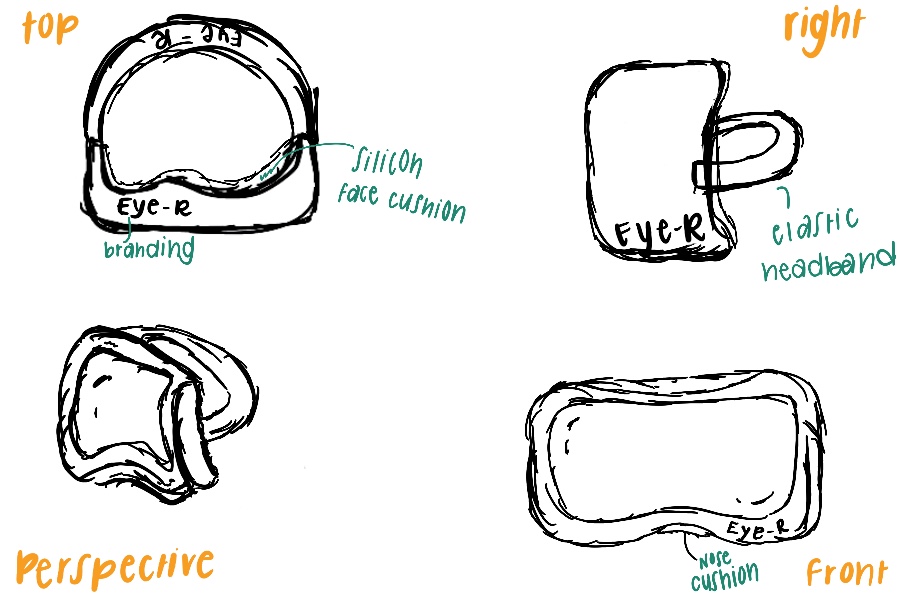
Orthographic sketches exploring the physical form of Eye-R.
Annotated concept sketch detailing key features and accessibility consideration
PROTOtyping

Building The Concept

I went from making orthographic sketches to a 3D model in Rhino 7, then rapidly prototyped a physical headset. Rather than waiting for a fully developed digital experience, I tested the concept early using interchangeable transparencies to simulate different eye conditions.

This let me validate what mattered most: did users feel the impact and did it change how they thought about their eye health?

3D printed low-fidelity prototype to use for testing
3D low-fidelity prototype using a transparency to simulate the experience
inside The experience

What Users See

These concept visuals represent what users would see inside the Eye-R headset for each simulated condition. Each experience tells the user what the condition is, what percentage of the population is affected, and what the typical symptoms feel like. Then it gives them a moment to look around and take it in before walking them through how it can be prevented.

Cataracts
Diabetic Retinopathy
Glaucoma
Floaters
Concept visuals generated using ChatGPT to simulate the in-headset experience.
User feedback

What Users Said

While the timeline didn't allow for formal user testing, I put the low-fidelity prototype in front of real users to validate the concept. The feedback was clear, the experience felt intuitive and users could immediately see its potential beyond the classroom.

Refelection

What I Learned

Every project teaches you something, and this is what Eye-R taught me.

Stakeholder Alignment
Leadership isn't always a title:
When communication broke down within the team I had to step up, realign everyone around the project goals, and keep things moving. I learned that being a designer sometimes means being the glue that holds the team together.
Research
Research humbled me:
I knew Gen Z was spending more time on screens, but I didn't expect was how many already had eye conditions and still had no idea what could happen if they go untreated. It was a gentle reminder that people dont ignore problems from lazyness, but rather beacuse they feel too far away to be real.
Design
The medium is in the message
The experience only works because it puts you inside the problem. That taught me that how you deliver information matters just as much as what you deliver.
Process
Constraints drive creativity:
A tight timeline and limited resources meant we couldn't overthink it. The lo-fi prototype with transparencies ended up being our most effective testing tool. Sometimes less forces better

Let's Connect

Have a project, opportunity, or feedback? I'd love to hear from you.
✨Thanks for reaching out, your message just landed in my orbit. I'll get back to you soon!
Something went wrong. Please try again or email  me directly.